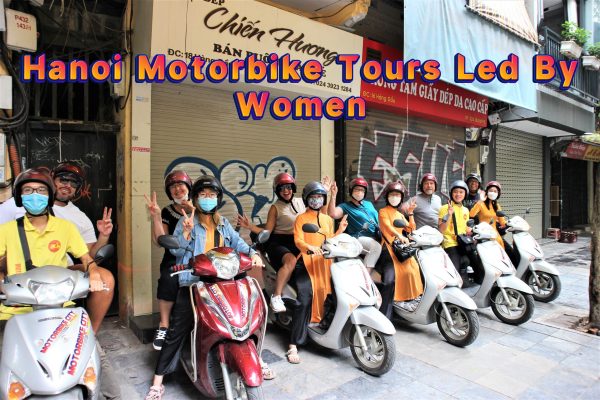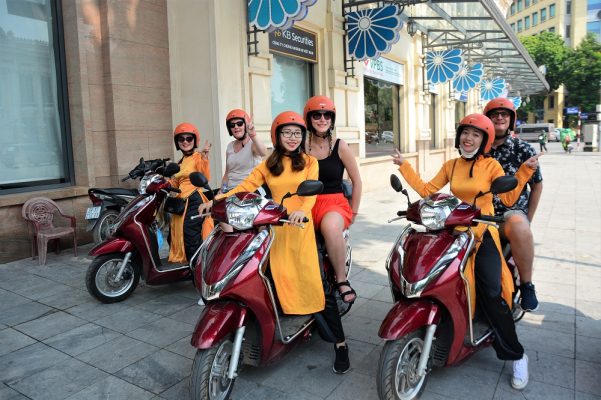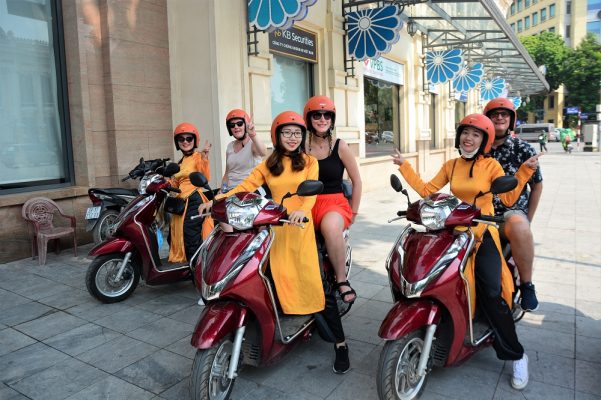
- Why do your female drivers wear Ao Dai? Vietnamese women in traditional dress Ao Dai is one of the most striking symbols of beauty in the country. However, nowadays, every Vietnamese woman prefers to wear it only on special occasions, such as traditional festivals and weddings… We want to contribute to preserving the heritage of Vietnamese women’s traditional Ao Dai at work. Because wearing the Ao Dai is practical and convenient, and it makes Vietnamese women appear charming and elegant. They do not have to think about what to wear to work every day. As a result, all of our female guides and drivers wear Ao Dai.
- Why do you hire female drivers? Because we feel Vietnamese women are the most responsible drivers in the country! Not only that, but we believe that Vietnamese women are among the hardest working, yet most undervalued, in the world!Women continue to constitute a huge majority of the working poor in Vietnam, as they do across the developing world, earn less money, and are more frequently impacted by under- and un-employment, as well as hazardous working circumstances, than males.
Our bookings fill up fast – Book your tour today to secure your spots! 📞 Call / WhatsApp / iMessage (24/7): +84 988 402 008 📧 Email: info@motorbikecitytours.com 🌐 Website: motorbikecitytours.com
The History of the Honda Lead: A Reliable Urban Scooter

The Honda Lead is a popular scooter series known for its practicality, fuel efficiency, and user-friendly design. It has been a staple in urban mobility, especially in Asia and Europe.
Origins & Early Models (1982–1990s)
- First Generation (1982–1988)
- Introduced as the Honda Lead 50 (NH50) and Lead 80 (NH80).
- Designed as a lightweight, automatic scooter for city commuting.
- Featured a 2-stroke engine and a compact frame.
- Second Generation (1988–1990s)
- Introduced Honda Lead 90 (NH90) and other variants.
- Improved engine performance and better fuel efficiency.
- Gained popularity in Europe and Japan.
Modernization & Expansion (2000s–2010s)
- Honda Lead 100 & 110 (2000s)
- Shifted to 4-stroke engines for lower emissions and better efficiency.
- Gained popularity in Vietnam, Thailand, and Indonesia as a trusted commuter scooter.
- Honda Lead 125 (2013–Present)
- Launched with a 125cc fuel-injected engine.
- Introduced PGM-FI (Programmed Fuel Injection) for improved mileage.
- Featured large under-seat storage and a modern, stylish design.
Current Models & Popularity
- The Honda Lead 125 remains a top choice in Vietnam, often used by commuters and families.
- It is praised for its reliability, low maintenance, and comfort.
- The latest models feature smart keys, LED lighting, and eco-friendly technology.
The Legendary UAZ Jeep

The UAZ (Ulyanovsk Automobile Plant) Jeep has a rich history rooted in Soviet military and civilian transportation. Here’s a brief overview:
Origins & Early Development (1940s–1950s)
- Post-WWII Need: After World War II, the Soviet Union sought to develop a reliable off-road vehicle similar to the American Willys Jeep.
- GAZ-69 (1953): The first major off-road vehicle developed was the GAZ-69, which was later transferred to UAZ for production in 1954.
- Birth of UAZ: UAZ, established in Ulyanovsk, Russia, took over GAZ-69 production in 1954, laying the foundation for its legendary off-road vehicles.
The UAZ-469 Era (1970s–1990s)
- UAZ-469 (1971): The most famous UAZ model, the UAZ-469, was introduced as a successor to the GAZ-69. It was designed for the Soviet military and was known for its:
- Rugged off-road capabilities
- Simple yet durable mechanical design
- Ability to withstand extreme weather conditions
- Military & Civilian Use: It became the go-to vehicle for the Soviet Army, KGB, police, and civilian off-roaders.
- Global Influence: Exported to various Warsaw Pact countries and even beyond, including Africa and the Middle East.
Modernization & New Models (1990s–Present)
- UAZ Hunter (2003): A modernized version of the UAZ-469, keeping the same rugged DNA but with improved comfort and reliability.
- UAZ Patriot (2005): A more modern SUV designed for both on-road and off-road use, appealing to a wider consumer market.
- Electric & Future Models: In recent years, UAZ has experimented with electric and hybrid versions, keeping the legacy alive.
Legacy & Popularity
- The UAZ Jeep remains an iconic off-roader, particularly in Russia, Vietnam, and former Soviet territories.
- It is widely used for adventure tours, including Hanoi Jeep Tours, thanks to its classic look and durable performance.
The History of Vespa: The Evolution of an Italian Icon

The Vespa is one of the most recognizable and beloved scooters in the world, symbolizing style, freedom, and Italian craftsmanship. Since its creation in 1946, it has become more than just a means of transportation—it’s a cultural icon.
Origins: Post-War Innovation (1946–1950s)
- Designed by Piaggio: After World War II, Italian aircraft manufacturer Piaggio needed a new product to revive its business.
- Corradino D’Ascanio’s Vision: An aeronautical engineer, D’Ascanio designed a scooter that was:
- Lightweight and easy to ride (no exposed chains or gears).
- Affordable for the masses.
- Stylish and practical.
- First Model – Vespa 98 (1946):
- Small 98cc engine, step-through frame, and unique wasp-like shape.
- Named “Vespa” (Italian for “wasp”) due to its narrow waist and buzzing sound.
- Quickly became popular in post-war Italy as an economical and stylish vehicle.
Global Expansion & Pop Culture Influence (1950s–1970s)
- 1950s: Vespa expanded across Europe, the USA, and Asia.
- Hollywood Fame: Featured in films like “Roman Holiday” (1953) starring Audrey Hepburn & Gregory Peck.
- 1960s: Became a symbol of the Mod subculture in Britain.
- 1970s: Entered the Vietnamese market, where it became a luxury scooter.
Modernization & Revival (1980s–Present)
- 1980s–1990s: Piaggio introduced new models with improved technology, such as automatic transmissions and fuel-efficient engines.
- 2000s: Launched Vespa LX, Primavera, and GTS models, combining classic design with modern performance.
- Present: The Vespa remains a premium scooter brand, offering electric models (Vespa Elettrica) and high-performance variants.
Legacy & Cultural Impact
- The Vespa remains a symbol of Italian elegance, beloved in Vietnam, Europe, and around the world.
- Used for Vespa tours in cities like Hanoi, offering a unique way to explore urban landscapes.
—————————————————————————————————————————————-