Hanoi Vespa Tour Through Hanoi’s Most Photogenic Streets
Hanoi is a dream destination for street photographers, but its most interesting photographs are not always found at the city’s famous monuments. Some of the best scenes appear unexpectedly: an old yellow house in a narrow alley, a fruit seller arranging a market stall, a Vespa disappearing around a corner, the Red River beneath Long Bien Bridge, green farmland hidden inside the city, or a lakeside road reflecting the afternoon light.
A Hanoi Vespa Tour Through Hanoi’s Most Photogenic Streets gives travelers a practical way to reach these different environments in a single experience. Instead of spending the entire day walking between attractions, you ride through Hanoi’s historic neighborhoods, backstreets, markets, countryside, lakes, and urban landmarks with an experienced driver-guide.
Motorbike City Tours specifically designs its Vespa routes around hidden alleys, vibrant neighborhoods, Long Bien Bridge, Banana Island, West Lake, Train Street, B-52 Lake, markets, French-style architecture, food stops, and Hanoi’s café culture.
Why Hanoi Is So Photogenic
Hanoi works particularly well for photography because several different visual worlds exist within a relatively small area.
You can photograph:
- Narrow Old Quarter alleys
- French colonial buildings
- Colorful markets
- Traditional tube houses
- Street food stalls
- Historic bridges
- Red River landscapes
- Banana and guava gardens
- West Lake
- Residential neighborhoods
- Railway-side streets
- Traditional cafés
- Modern Hanoi architecture
The biggest advantage of a Vespa is that you can move between these environments quickly without losing the atmosphere of the street.
Why Explore Hanoi by Vespa for Photography?
A sightseeing bus keeps you on major roads.
Walking gives you excellent access to small streets but limits how far you can travel.
A Vespa offers a useful combination of both.
You can ride through narrow streets, stop when an interesting scene appears, cross the city quickly, and reach completely different photographic environments within the same tour.
Motorbike City Tours’ Vespa experiences are designed to reach places that larger vehicles cannot easily access, with guests riding as passengers behind experienced drivers.
1. The Old Quarter’s Narrow Alleys
The Old Quarter is one of the best places to begin a Hanoi photography tour.
Forget trying to photograph only the famous streets.
The smaller lanes are often more interesting.
Look for:
- Old balconies
- Hanging laundry
- Motorbikes parked outside homes
- Small food stalls
- Shopfronts
- Flower sellers
- Street vendors
- Traditional architecture
- Residents sitting outside their homes
The combination of narrow streets and dense architecture creates strong lines and layers for photographs.
A Vespa can take you deeper into these backstreets than a standard sightseeing vehicle.
2. Early-Morning Hanoi Streets
Morning is one of the best times for street photography.
The city is already active, but the streets can feel calmer than during the busiest parts of the day.
You may see people buying breakfast, opening shops, preparing food, exercising, delivering goods, or carrying flowers and vegetables to markets.
For photographers, these moments are often more valuable than posed photographs because they show Hanoi naturally.
3. Hanoi’s Colorful Markets
Markets provide some of the strongest colors in the city.
Fresh herbs, tropical fruit, vegetables, flowers, seafood, and prepared foods create constantly changing compositions.
Motorbike City Tours includes bustling markets in its Vespa routes, allowing travelers to see Hanoi’s everyday commercial life rather than only major tourist attractions.
A market is also a good place to practice respectful candid photography.
Always be considerate when photographing people, particularly vendors and children.
4. French Colonial Architecture
Hanoi’s French architectural heritage creates a completely different photographic style.
Broad streets, yellow façades, shutters, balconies, trees, and old villas contrast sharply with the narrow Old Quarter.
The Vespa route passes notable landmarks and French-style villas, including areas around the Hanoi Opera House and the French Quarter.
For architecture photographers, these streets are particularly rewarding in softer morning or late-afternoon light.
5. Hanoi Opera House
The Hanoi Opera House is one of the city’s most recognizable colonial buildings.
Its pale façade, columns, surrounding streets, and nearby historic architecture create several different compositions.
Rather than simply stopping for one photograph, a Vespa tour allows you to see the Opera House as part of the wider French Quarter environment.
Motorbike City Tours lists the Opera House among the major landmarks passed during its Vespa city experience.
6. Long Bien Bridge
For many photographers, Long Bien Bridge is one of the highlights of the entire route.
The century-old structure provides layers of railway tracks, metal framework, river views, traffic, and distant city scenery.
The bridge was constructed during the French colonial period and has become an enduring symbol of Hanoi.
Motorbike City Tours includes Long Bien Bridge in its Vespa itinerary and highlights its views toward the Red River and the city’s rural edges.
Photography Tip
Don’t photograph only the bridge itself.
Look for:
- Railway lines
- Repeating metal structures
- Cyclists
- Scooters
- Riverboats
- Farmland
- City skyline
- People crossing the bridge
These elements can turn a familiar landmark into a more personal photograph.
7. The Red River Landscape
Long Bien Bridge also provides access to one of Hanoi’s most unexpected photographic environments: the Red River landscape.
From elevated viewpoints, the city and countryside appear together.
You may see green agricultural areas below, boats on the river, railway infrastructure, and Hanoi’s growing skyline in the distance.
The contrast between urban development and agriculture is one of the defining visual characteristics of Hanoi.
8. Banana Island
After crossing Long Bien Bridge, the Vespa route can continue into Banana Island.
This is one of the most unusual photographic locations in Hanoi.
Instead of concrete streets and dense buildings, you find:
- Banana trees
- Guava trees
- Vegetable gardens
- Dirt paths
- Farmland
- Farmers
- Green fields
- Small agricultural plots
Motorbike City Tours describes Banana Island as Hanoi’s agricultural countryside and includes it as a major stage of its Vespa experience.
Why Photographers Like Banana Island
The visual contrast is excellent.
You can photograph a farmer working in a green field with the skyline of a rapidly developing capital city somewhere in the background.
It is difficult to imagine that such scenery exists so close to central Hanoi until you see it yourself.
9. Dirt Paths and Green Canopies
The narrow dirt paths of Banana Island provide a completely different photographic atmosphere.
The Vespa moves beneath banana and guava trees, creating natural frames and tunnels of greenery.
This is a particularly good place for:
- Environmental portraits
- Nature photography
- Documentary photography
- Wide-angle landscapes
- Detail shots
- Travel photography
The slower pace also makes it easier to stop and compose photographs.
10. West Lake
After the countryside section, the route returns toward West Lake.
West Lake provides open space after the density of Hanoi’s smaller streets.
The lakeside roads offer:
- Water reflections
- Trees
- Temples
- Villas
- Cafés
- Boats
- Cyclists
- Joggers
- Urban skyline views
Motorbike City Tours specifically includes West Lake as a photographic section of its city Vespa routes.
11. Truc Bach Lake
Nearby Truc Bach Lake provides another opportunity for quieter photographs.
The smaller lake has a more intimate atmosphere, surrounded by restaurants, homes, cafés, and streets.
It can be particularly interesting for photographers who prefer environmental scenes rather than postcard-style landscapes.
12. Huu Tiep Lake and the B-52 Wreckage
Another unusual photographic location is Huu Tiep Lake, where the remains of a B-52 bomber can be seen.
The site is surrounded by an ordinary residential neighborhood.
That contrast is what makes it visually powerful.
A historical relic sits within a living community of homes, narrow lanes, trees, and everyday activity.
Motorbike City Tours includes the B-52 wreckage site among the highlights of its Vespa city route.
13. Ngoc Ha Flower Village Area
The B-52 site is located in the broader Ngoc Ha area, historically associated with flower growing.
The surrounding narrow streets can provide interesting documentary photographs, particularly when residents are working with plants, flowers, and household gardens.
It is another example of how Hanoi’s older traditions remain embedded within the modern city.
14. Train Street
Hanoi Train Street is one of the city’s most recognizable photographic locations.
The railway runs through an exceptionally narrow residential environment, with houses and businesses positioned very close to the tracks.
Motorbike City Tours includes Train Street as a highlight of its Vespa routes.
However, photographers should remember that the railway is active infrastructure.
The correct approach is to follow your guide’s instructions and current safety regulations rather than trying to get closer to the tracks for a photograph.
The neighborhood itself can provide excellent documentary images without taking unnecessary risks.
15. Photograph Everyday Life, Not Just Landmarks
One of the biggest advantages of this type of Vespa tour is that the most memorable photographs may happen between official stops.
A woman preparing breakfast.
A man repairing a bicycle.
A child leaving school.
A flower seller cycling through a narrow lane.
A café owner opening for the morning.
A street vendor arranging fruit.
These scenes tell a stronger story about Hanoi than a collection of monuments alone.
16. Vespa and Street Photography
The Vespa itself can become part of your photographic story.
A classic-style scooter moving through Hanoi’s narrow streets creates a strong visual connection with the city.
You can photograph:
- Your female driver
- Other scooters
- Vespa details
- Old buildings
- Street signs
- Markets
- Traffic
- Reflections
- Passing pedestrians
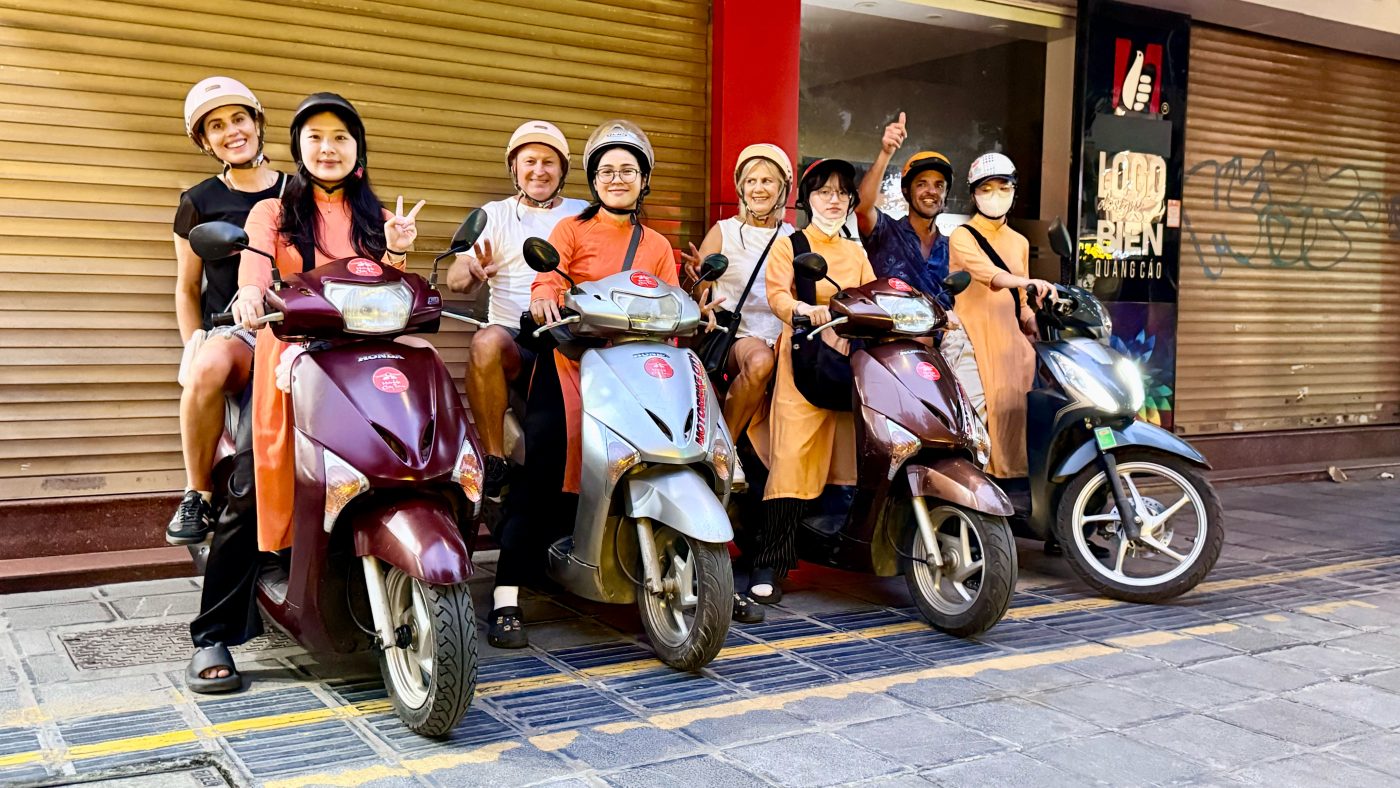
Motorbike City Tours offers Vespa tours led mainly by licensed female drivers, making the rider-and-Vespa combination another natural photographic element.
17. Female Drivers in Traditional Ao Dai
Motorbike City Tours explains that its female guides and drivers wear Ao Dai as part of its women-led tour identity and to preserve the tradition of Vietnamese women’s dress at work.
For photographers, this creates an opportunity to combine:
Vietnamese traditional clothing + Vespa + Hanoi street life.
A photograph of an Ao Dai-clad rider moving through an old Hanoi neighborhood can communicate several elements of Vietnamese culture in one frame.
18. Photographing From the Passenger Seat
You do not need professional photography equipment to enjoy the tour.
A smartphone can produce excellent images from the passenger seat.
The most important thing is to remain aware of the movement of the Vespa.
For important photographs, ask your driver to stop rather than trying to take complicated shots while moving.
A short pause can give you much better composition and a safer shooting position.
19. Best Camera Equipment for the Tour
If you are bringing a dedicated camera, keep it simple.
A good setup could be:
- Mirrorless or DSLR camera
- 24–70mm equivalent lens
- Small prime lens
- Smartphone
- Extra battery
- Spare memory card
- Lens cloth
- Compact camera bag
You generally do not need a large telephoto lens.
A lightweight setup makes the Vespa experience much more comfortable.
20. Best Time of Day for Photography
Morning
Morning light works particularly well for:
- Markets
- Old Quarter streets
- Residential neighborhoods
- Long Bien Bridge
- Banana Island
The city is active and the light can be softer.
Afternoon
Afternoon rides can provide stronger contrast and warmer light later in the day.
This is particularly useful around:
- West Lake
- Long Bien Bridge
- French Quarter
- Residential streets
Evening
An evening Vespa experience creates a completely different photographic style.
Street lights, restaurant signs, headlights, cafés, and illuminated buildings create opportunities for night photography.
Motorbike City Tours also offers Vespa food experiences in the evening, combining street exploration with Vietnamese food and café stops.
21. Don’t Spend the Whole Tour Behind the Camera
This is important.
Hanoi is visually overwhelming.
If you try to photograph everything, you may miss the experience itself.
Put the camera away occasionally.
Listen to the traffic.
Smell the food.
Watch the markets.
Talk to your guide.
Look at the architecture.
Then take the camera out again when something genuinely catches your attention.
The best travel photographs often come from moments when you were already enjoying the place.
22. A Typical Photographic Route
A well-planned Hanoi Vespa photography experience can combine several different environments:
Old Quarter → narrow alleys and traditional architecture
French Quarter → colonial buildings and broad streets
Long Bien Bridge → railway, river, and city views
Banana Island → farmland, gardens, and rural life
West Lake → water, temples, cafés, and urban scenery
Huu Tiep Lake → history and residential neighborhoods
Train Street → railway and dense urban life
Hanoi café → egg coffee and street scenes
Motorbike City Tours’ published routes use many of these locations, creating a substantial variety of photographic subjects within one tour.
23. How Long Should Photographers Book?
2.5-Hour Tour
The 2.5-hour Vespa tour is suitable if you want a compact introduction to Hanoi’s photographic streets.
Motorbike City Tours currently lists the group price at $40 USD and the private price at $50 USD per person for this experience.
4.5-Hour Tour
For serious photographers, the 4.5-hour city and countryside Vespa tour provides considerably more variety.
The published schedule is:
Morning: 8:00 AM–12:45 PM
Afternoon: 1:00 PM–5:30 PM
The current published price is $69 USD per person, with a direct booking price of $59 USD.
The longer route gives you time to move from dense urban streets to countryside, lakes, historic sites, and food stops.
24. Private Vespa Tour for Photographers
A private tour can be particularly valuable if photography is your main objective.
You can communicate with your driver-guide about the types of photographs you want.
For example, you may prefer:
- Architecture
- Street portraits
- Food photography
- Rural landscapes
- Documentary photography
- Night photography
- Traditional Vietnamese culture
The route can then be adjusted around your priorities, traffic, weather, and available time.
25. What Should Photographers Wear?
Comfort matters more than fashion.
Recommended:
- Comfortable trousers or shorts
- Breathable shirt
- Comfortable walking shoes
- Sunglasses
- Sunscreen
- Light jacket
- Small camera bag
Motorbike City Tours recommends light and comfortable clothing and shoes, along with sunscreen, sunglasses, and a light jacket or long sleeves when appropriate.
26. What Equipment Is Provided?
The Vespa experience includes practical riding equipment.
Motorbike City Tours lists:
- Passenger-backrest scooters
- Helmets
- Raincoats when needed
- Face masks
- Bottled water
- Drinks
- Experienced licensed drivers
- Hotel pickup and drop-off
The company also states that its helmets are cleaned and maintained, while its scooters are regularly inspected.
Your photography equipment remains your responsibility, so keep cameras and phones secure while riding.
27. Who Is This Tour Best For?
A Hanoi Vespa photography tour is particularly suitable for:
- Street photographers
- Travel bloggers
- Content creators
- Instagram photographers
- Documentary photographers
- Couples who enjoy photography
- First-time Hanoi visitors
- Repeat visitors looking for new perspectives
- Travelers who prefer experiences over standard sightseeing
You do not need professional photography skills.
A smartphone is enough to enjoy the route.
28. The Biggest Photographic Advantage: Variety
Perhaps the strongest reason to choose a Vespa is variety.
Within a few hours, you can photograph environments that look completely unrelated:
Dense historic streets.
French colonial architecture.
A century-old bridge.
A rural agricultural island.
A huge urban lake.
A historical war relic.
A railway neighborhood.
A traditional Vietnamese café.
Few sightseeing formats can combine this many visual environments so efficiently.
Final Thoughts
A Hanoi Vespa Tour Through Hanoi’s Most Photogenic Streets is ideal for travelers who want photographs that go beyond the standard Hanoi postcard.
You can capture the texture of the Old Quarter, the architecture of the French Quarter, the structure of Long Bien Bridge, the greenery of Banana Island, the open views around West Lake, the history of Huu Tiep Lake, and the unusual atmosphere around Train Street.
More importantly, you can photograph Hanoi as a living city.
The people.
The food.
The markets.
The homes.
The traffic.
The gardens.
The cafés.
The unexpected moments between the famous sights.
That is what makes Hanoi such a rewarding destination for street and travel photography.
Book a Hanoi Vespa Photography Experience
Website: motorbikecitytours.com
WhatsApp / Call / iMessage 24/7: +84 988 402 008
Email: info@motorbikecitytours.com
2.5-Hour Vespa Tour: from $40 USD per person
Private 2.5-Hour Tour: from $50 USD per person
4.5-Hour City & Countryside Vespa Tour: $69 USD per person / direct booking $59 USD
Morning: 8:00 AM–12:45 PM
Afternoon: 1:00 PM–5:30 PM
Motorbike City Tours also offers private Vespa experiences for travelers who want to prioritize photography, food, architecture, countryside scenery, or Hanoi street life.