Hanoi Vespa Tour: Understanding Modern Hanoi Through Local Life
A Hanoi Vespa Tour can reveal a side of the capital that is easy to miss when you only visit famous monuments. Modern Hanoi is not defined by Hoan Kiem Lake, the Old Quarter, or colonial buildings alone. It is also the morning markets, narrow residential lanes, family businesses, cafés, schools, farms beside the Red River, lakeside neighborhoods, and millions of everyday journeys happening around them.
Traveling by Vespa gives you a street-level perspective on this constantly changing city. Instead of moving directly between major attractions, you can connect different neighborhoods and see how traditional Vietnamese life exists alongside modern Hanoi.
Motorbike City Tours focuses its Vespa experiences on backstreets, markets, residential areas, Long Bien Bridge, Banana Island, West Lake, B-52 Lake, Train Street, food stops, and other places that reveal a less obvious side of the capital.
Modern Hanoi Is More Than Its Tourist Attractions
For a first-time visitor, Hanoi can initially appear to be a city of famous landmarks.
There is Hoan Kiem Lake, the Old Quarter, the Temple of Literature, the French Quarter, Ho Chi Minh Mausoleum, and countless historic buildings.
But these places only tell part of the story.
Modern Hanoi is also about how people live around those landmarks.
Walk a few streets away and you may find a family running a small restaurant from the ground floor of its home, a neighborhood coffee shop filled with residents, a traditional market operating beside modern apartments, or an elderly person sitting outside an old house while scooters stream past.
A Vespa tour allows you to connect these different layers.
Why a Vespa Is a Good Way to Understand Hanoi
Hanoi’s streets are constantly changing.
A large vehicle often has to remain on major roads. Walking allows you to explore narrow streets but limits how far you can travel within a few hours.
A Vespa provides a useful middle ground.
You can move quickly across the city while still entering smaller lanes and residential areas.
Motorbike City Tours describes its Vespa routes as reaching hidden streets and narrow alleys that larger vehicles cannot easily access.
This means the journey between attractions becomes part of the experience.
Start With the Old Quarter—Then Go Further
The Old Quarter is a natural starting point because it introduces visitors to Hanoi’s dense urban environment.
Its narrow streets, old houses, food stalls, cafés, shops, and constant traffic create an immediate impression of the capital.
But a modern Hanoi Vespa experience should not stop there.
The interesting question is:
What happens when you leave the tourist streets?
The route can move into residential neighborhoods, smaller markets, lakeside roads, and areas where everyday life becomes more visible.
Discover Hanoi’s Residential Streets
Residential streets show how the city functions behind its major attractions.
You may pass homes with small businesses on the ground floor, neighborhood restaurants, repair shops, cafés, schools, temples, and tiny food stalls.
Some houses are narrow and tall, reflecting Hanoi’s traditional tube-house architecture.
Others have been renovated with modern interiors while retaining their original narrow footprint.
This mixture of old and new is one of the defining characteristics of modern Hanoi.
Watch a Traditional Market Come to Life
Markets provide another window into contemporary Vietnamese life.
A neighborhood market can reveal what people actually buy and cook during the day.
You might see:
- Fresh vegetables
- Tropical fruit
- Herbs
- Meat
- Seafood
- Flowers
- Prepared foods
- Household products
- Snacks and drinks
Motorbike City Tours includes markets in its Vespa itineraries, giving travelers opportunities to observe everyday activity rather than limiting the experience to major tourist attractions.
For visitors interested in Vietnamese food, this is especially valuable because many ingredients used in restaurants can be seen in their raw form at the market.
Cross Long Bien Bridge and See the Red River
One of the most effective ways to understand Hanoi’s geography is to cross Long Bien Bridge.
The historic bridge spans the Red River and connects the dense urban center with areas containing agricultural land and river communities.
From the bridge, the city suddenly feels much larger.
You can see railway tracks, boats, farms, riverbanks, high-rise buildings, and older neighborhoods in the same landscape.
Motorbike City Tours includes Long Bien Bridge in its Vespa routes and uses the Red River area as a transition between urban Hanoi and its agricultural surroundings.
See the Rural Side of a Modern Capital
One of the most surprising aspects of Hanoi is how quickly the scenery can change.
After crossing the Red River, a Vespa can take you toward Banana Island, where agricultural land sits surprisingly close to central Hanoi.
Motorbike City Tours includes Banana Island in its Vespa itineraries, highlighting its gardens, crops, and rural scenery.
This area demonstrates that modernization has not completely replaced traditional agriculture.
Instead, the two exist side by side.
You can see modern buildings in the distance while farmers continue working the land nearby.
Banana Island and the Future of Hanoi
Banana Island provides an interesting perspective on Hanoi’s development.
The city is growing rapidly, with new buildings, roads, businesses, and residential developments appearing across the metropolitan area.
Yet agricultural spaces remain within the urban landscape.
Seeing this contrast from a Vespa helps travelers understand that Hanoi’s transformation is not simply a move from “old” to “new.”
Different periods of the city coexist.
See Modern Hanoi Around West Lake
After the Red River countryside, the route can return toward West Lake.
West Lake represents another side of contemporary Hanoi.
Here you can find lakeside cafés, restaurants, modern residences, hotels, apartment buildings, temples, and international businesses.
The roads around the lake are generally more open than those in the Old Quarter.
Motorbike City Tours includes West Lake among the highlights of its Hanoi Vespa routes.
The area demonstrates how Hanoi has developed into a modern metropolitan city while maintaining older cultural spaces.
Truc Bach: A Different Urban Atmosphere
Nearby Truc Bach Lake offers another contrast.
The smaller lake is surrounded by restaurants, residential buildings, cafés, and busy streets.
From a Vespa, you can observe the transition between the lakeside environment and the surrounding neighborhoods without needing to stop at every location.
This is one of the advantages of sightseeing on two wheels.
Huu Tiep Lake: History Inside Everyday Life
Modern Hanoi is built around layers of history.
At Huu Tiep Lake, the remains of a B-52 bomber can be seen in the water.
What makes the location particularly interesting is its surroundings.
This is not an isolated historical monument. It is integrated into an ordinary residential neighborhood.
People live, work, shop, and move around the area while an important historical reminder remains nearby.
Motorbike City Tours includes B-52 Lake among its Vespa sightseeing stops.
The location provides an excellent example of how history remains part of modern Hanoi rather than being separated from it.
Train Street and Hanoi’s Urban Density
Hanoi Train Street is another unusual example of how old infrastructure and modern city life coexist.
The railway runs through an extremely narrow residential environment, with homes, cafés, and businesses positioned close to the tracks.
Motorbike City Tours includes Train Street in its published Vespa routes.
The important thing for visitors is to follow current safety regulations and their guide’s instructions. The railway remains active infrastructure.
What makes the location culturally interesting is the surrounding neighborhood and the way residents have adapted to an unusual urban environment.
Modern Hanoi’s Coffee Culture
Coffee is an important part of contemporary Hanoi.
Small cafés can be found almost everywhere, from narrow Old Quarter buildings to modern lakeside spaces.
People meet friends, work, read, talk, and watch traffic while drinking Vietnamese coffee.
A Vespa tour can introduce you to this culture in the neighborhoods where people actually spend their time.
Motorbike City Tours includes Vietnamese egg coffee on several of its Vespa itineraries.
Egg Coffee: A Hanoi Tradition That Became Modern
Egg coffee is a particularly interesting example of Hanoi’s ability to adapt traditions.
Strong Vietnamese coffee is combined with a creamy egg mixture, creating a drink that feels both traditional and contemporary.
It is now associated strongly with Hanoi’s café culture.
Stopping for egg coffee during a Vespa tour provides more than a food tasting. It gives you time to sit down, talk with the guide, and observe another part of city life.
Modern Hanoi Through Food
Food is another way to understand contemporary Hanoi.
Street food remains deeply integrated into daily life.
People eat breakfast before work, stop for noodles during the day, meet friends at cafés, and gather at small restaurants in the evening.
Motorbike City Tours combines its Vespa experiences with Vietnamese food, markets, coffee, and other culinary stops.
Instead of treating food as a separate activity, the tour connects what people eat with where they live and work.
Bún Chả and Hanoi Identity
Bún Chả is a good example.
Grilled pork, rice noodles, herbs, vegetables, and dipping sauce create a dish that is strongly associated with Hanoi.
Eating it at a neighborhood restaurant gives you an opportunity to see how a famous Vietnamese dish fits into everyday dining.
The same applies to Bánh Cuốn, Banh Mi, pho, and other foods found throughout the city.
See How Old Houses Adapt to Modern Life
One of the most interesting aspects of Hanoi is its architecture.
Traditional tube houses can be extremely narrow but surprisingly deep.
As families and businesses have changed, many of these buildings have been renovated and adapted to modern needs.
A home might have a café on the ground floor, bedrooms above, and a small family business operating at street level.
This architecture provides a physical explanation of how Hanoi has modernized without completely abandoning its older urban structure.
Women Guides and a More Personal Hanoi Experience
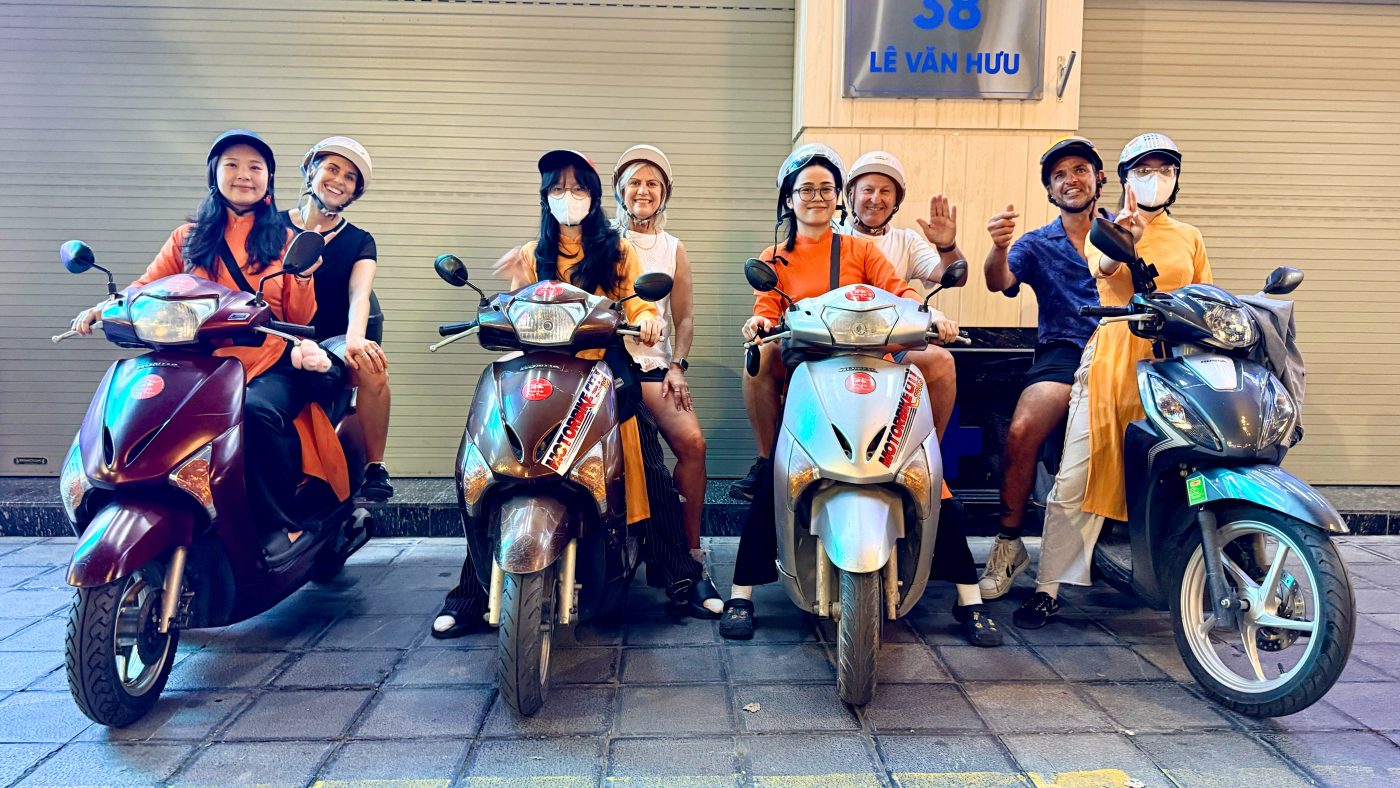
Motorbike City Tours offers Vespa experiences led by female riders and guides.
The company’s published tour information emphasizes professional female drivers, English-speaking guides, cultural explanations, and small-group experiences.
For visitors, the advantage is having someone who can explain what is happening around you while navigating the city.
You can ask questions about food, family life, neighborhoods, traditions, architecture, or the changes taking place in Hanoi.
You Don’t Need to Drive
You experience Hanoi as a passenger.
The professional driver handles navigation and traffic while you watch the city.
Motorbike City Tours states that guests do not need previous riding experience and ride behind licensed driver-guides.
This makes the format accessible to travelers who want the excitement of a scooter journey without taking on the responsibility of driving themselves.
A Comfortable Way to Explore
The Vespa experiences use passenger backrests, while helmets and rain protection are provided according to the published tour information.
This is useful because understanding Hanoi through its neighborhoods requires moving between different parts of the city.
The goal is not to spend hours continuously riding.
A good route alternates between riding, stopping, walking briefly, eating, taking photographs, and talking with the guide.
How Long Should a Modern Hanoi Vespa Tour Be?
2.5 Hours
A 2.5-hour tour works well if you want a compact introduction.
The published route includes Hanoi’s backstreets, Long Bien Bridge, Banana Island, West Lake, B-52 Lake, Train Street, and a café stop.
4.5 Hours
A longer 4.5-hour experience provides more time for food, markets, countryside scenery, cultural stops, and conversations with your guide.
Motorbike City Tours publishes morning and afternoon departures for this longer experience.
Full-Day Exploration
For travelers who want to understand more of Hanoi’s surrounding countryside, a longer city-and-outskirts route can combine urban neighborhoods with farms, villages, traditional houses, and historical sites.
Who Should Take This Hanoi Vespa Tour?
This experience is especially suitable for:
- First-time visitors
- Repeat visitors who have already seen the main attractions
- Couples
- Families with teenagers
- Photographers
- Food lovers
- Travelers interested in Vietnamese culture
- Travelers interested in urban development
- Visitors who prefer small-group experiences
- People who want to see both modern and traditional Hanoi
What Should You Wear?
Choose practical clothing suitable for both riding and walking.
Recommended:
- Lightweight clothing
- Comfortable trousers or shorts
- Comfortable shoes
- Sunglasses
- Sunscreen
- Light jacket for morning or evening rides
- Small personal bag
Avoid carrying a large backpack because it can be inconvenient while sitting on the Vespa.
What Is Included?
Depending on the selected Motorbike City Tours itinerary, the published Vespa experiences can include:
- Vintage Vespa
- Professional licensed driver
- English-speaking guide
- Passenger backrest
- Helmet
- Hotel pickup and drop-off
- Food and drinks on applicable tours
- Vietnamese egg coffee
- Entrance fees where specified
- Rain poncho when necessary
The exact inclusions vary by product, so travelers should confirm the details for the specific tour they choose.
The Best Way to Understand Modern Hanoi
The most interesting part of a Hanoi Vespa tour is often not the destination.
It is the transition between destinations.
You leave the Old Quarter and enter residential streets.
You leave the city center and reach the Red River.
You cross Long Bien Bridge and find farmland.
You leave the countryside and return to West Lake.
You pass historical remains surrounded by modern homes.
You stop at a café where young people use smartphones while drinking a coffee with a recipe that has become part of Hanoi’s cultural identity.
That is modern Hanoi.
Final Thoughts
A Hanoi Vespa Tour: Understanding Modern Hanoi Through Local Life gives travelers a broader view of the capital.
It connects the Old Quarter with residential neighborhoods, Long Bien Bridge with the Red River, Banana Island with modern development, Huu Tiep Lake with contemporary life, and West Lake with Hanoi’s growing café and residential culture.
Instead of asking only “What should I see in Hanoi?”, the Vespa experience encourages a more interesting question:
“How does Hanoi actually work?”
The answer is found in its streets, food, markets, homes, businesses, farms, cafés, lakes, bridges, and the people moving through them every day.
Book a Hanoi Vespa Tour
Website: motorbikecitytours.com
WhatsApp / Call / iMessage 24/7: +84 988 402 008
Email: info@motorbikecitytours.com
Motorbike City Tours offers 2.5-hour and longer Hanoi Vespa experiences, including routes through hidden streets, Long Bien Bridge, Banana Island, West Lake, B-52 Lake, Train Street, markets, food stops, and other parts of Hanoi that reveal the city beyond its main tourist attractions.